


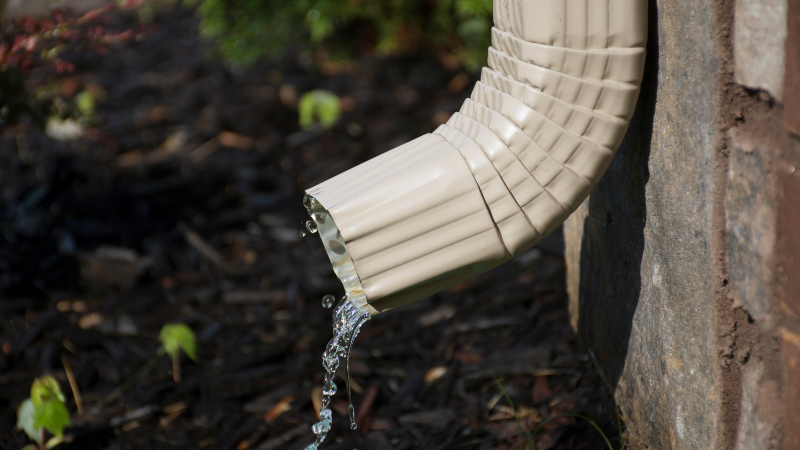
When rain hits your roof, your gutter system has one important job: collect that water and move it safely away from your home. But getting water into the downspout is only half the equation. Where that water goes next can make a major difference in protecting your roof, siding, landscaping and foundation.
Proper downspout drainage is especially important for Central Iowa homeowners. Heavy thunderstorms can drop a significant amount of water in a short period of time, while melting snow and freeze-thaw cycles create additional drainage challenges throughout the year.
If your downspouts empty too close to your house, or the surrounding grade sends that water right back toward the foundation, the drainage system may not be doing much good.
Here’s what homeowners should know about where downspouts should drain and how to spot potential problems before they lead to costly damage.
How Far Should Downspouts Drain From Your House?
Effective downspout drainage isn’t just about distance, it’s about where the water ultimately goes. Soil conditions, landscaping and grading all effect drainage, but the goal is simple: move water away from your foundation and keep it moving in that direction.
If a downspout empties too close to your home, repeated heavy rain can saturate the surrounding soil, contributing to erosion, basement moisture and foundation problems. A downspout extension can help by carrying water farther away, but it should discharge onto ground that slopes away from the house. Otherwise, water may simply flow back toward the foundation.
After a heavy rain, check for pooling near the foundation, washed-out landscaping, erosion or areas that stay wet long after the storm has passed. These can indicate that grading or drainage needs attention.
For most Central Iowa homes, underground drainage is another option. These systems keep extensions out of the way while carrying water farther from the home. However, both above- and below-ground extensions can become clogged with debris. If an underground system backs up during heavy rain, the blockage may be farther down the drainage line rather than in the gutter itself.
How Poor Drainage Can Damage Your Foundation
One of the biggest reasons to take downspout placement seriously is the potential for foundation water damage.
When water repeatedly collects against your foundation, the surrounding soil can become saturated. Moisture may find its way into small cracks or weak points and contributing to damp basements or crawl spaces. Repeated saturation can also cause soil to expand, contract or erode around the foundation.
The goal of your gutter system isn't merely to get rainwater off the roof. It's to manage that water all the way from the roof to a safe discharge point.
Your Siding Can Also Show Signs of Drainage Problems
Water splashing repeatedly near the base of your home can expose siding and trim to unnecessary moisture. Overflowing gutters can also send water down exterior walls rather than through the downspouts.
Depending on your siding material, you may notice staining, discoloration, mildew or deterioration around areas that regularly get wet.
If you notice siding damage concentrated around a downspout or corner of the house, look at the entire drainage path rather than treating the siding as an isolated problem.
Fixing the visible damage without addressing where the water is coming from means you're likely to see the same problem again.
Signs Water May Be Draining Back Toward Your Home
The tricky thing about drainage problems is that water doesn't always travel in the direction you'd expect. An extension may appear to point away from your house, but the surrounding grade could send the water right back.
Some warning signs include:
- Standing water/damp soil
- Erosion/washed-out mulch
- Siding staining
- Basement moisture
- Downspout backup
- Water or ice accumulating near the discharge area
If you're seeing the same wet areas after every storm, that's worth investigating.
Protecting Your Central Iowa Home Starts With Getting the Details Right
Iowa weather puts our homes through a lot. Heavy rain, hail, snow, ice and dramatic temperature swings are simply part of living here. Your home's exterior systems need to work together to handle those conditions year after year.
As a local, family-owned company serving Central Iowa, Hedrick Construction believes protecting a home comes down to doing the details right and recommending solutions that make sense for the homeowner and the property.
If you're concerned about your gutters, downspouts or another part of your home's exterior, Hedrick Construction can help you understand what's happening and determine the right next step.


.png)

Comments